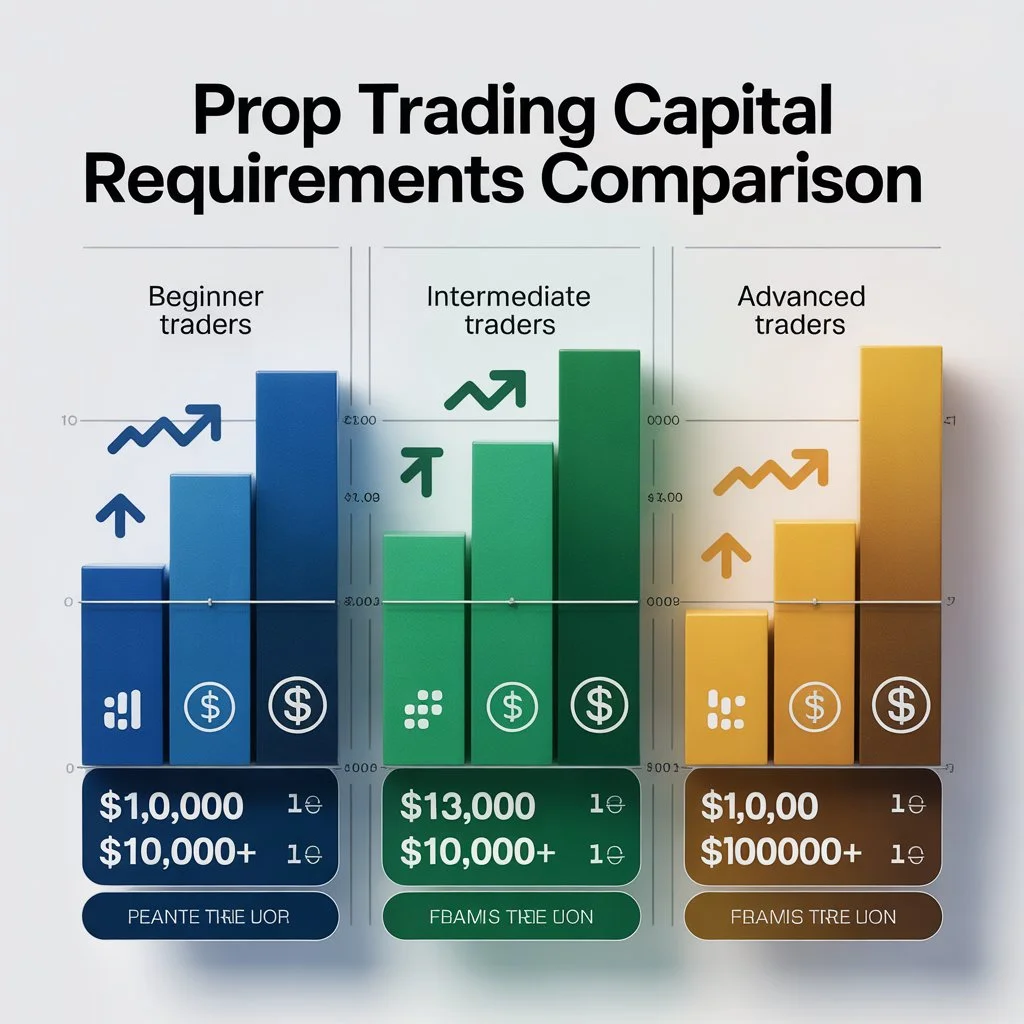
If you’re stepping into the world of proprietary trading, one of the first questions that comes to mind is simple: how much capital do you actually need?
Many traders assume they need thousands of dollars to start. But in reality, prop trading capital requirements vary widely depending on the firm, funding model, and your trading performance.
Whether you’re a beginner or an active trader looking to scale, understanding how capital works in prop firms can save you time, money, and frustration. In this guide, we’ll break everything down in a simple, practical way—so you can choose the right path confidently.
Prop trading capital requirements depend on the firm and model. Some firms require no upfront capital but charge evaluation fees, while others require deposits starting from $50 to $10,000+. Most proprietary firms provide funding based on performance, allowing traders to scale capital without risking large personal funds.
Table of Contents
- What Are Prop Trading Capital Requirements?
- Types of Prop Firm Funding Models
- How Much Capital Do You Need to Start?
- Prop Firm Minimum Capital vs Personal Trading
- Key Trader Capital Rules Explained
- Real Examples of Prop Trading Funding
- Comparison Table of Capital Requirements
- Pros and Cons of Prop Firm Capital Models
- How to Choose the Right Capital Model
- FAQ Section
- Conclusion
What Are Prop Trading Capital Requirements?
Prop trading capital requirements refer to the amount of money a trader needs to access or control capital within a proprietary trading firm.
Unlike retail trading, where you risk your own money, prop firms allow you to trade using their funds. However, there are usually conditions such as:
- Evaluation fees
- Profit targets
- Risk management rules
- Drawdown limits
These rules are often called trader capital rules, and they determine how much capital you can access and keep.
Types of Prop Firm Funding Models
Understanding funding models is key to knowing your trading capital needed.
1. Evaluation-Based Model
This is the most common model today.
How it works:
- Pay a small fee (e.g., $50–$500)
- Pass a trading challenge
- Get funded account ($10,000–$200,000)
Best for:
- Beginners with low capital
2. Instant Funding Model
No evaluation required.
Features:
- Higher upfront cost
- Immediate access to capital
- Lower leverage or stricter rules
3. Traditional Prop Firms
These are professional firms (often office-based or institutional).
Requirements:
- Proven track record
- Interviews
- Sometimes personal capital contribution
How Much Capital Do You Need to Start?
The truth is: there is no fixed number.
Here’s a general breakdown of prop firm account minimums:
- Low entry: $50–$150
- Mid-level: $200–$500
- Advanced: $1,000+
- Institutional: $10,000+
However, this is not always your trading capital—it’s often just an entry or evaluation fee.
Prop Firm Minimum Capital vs Personal Trading
Let’s compare:
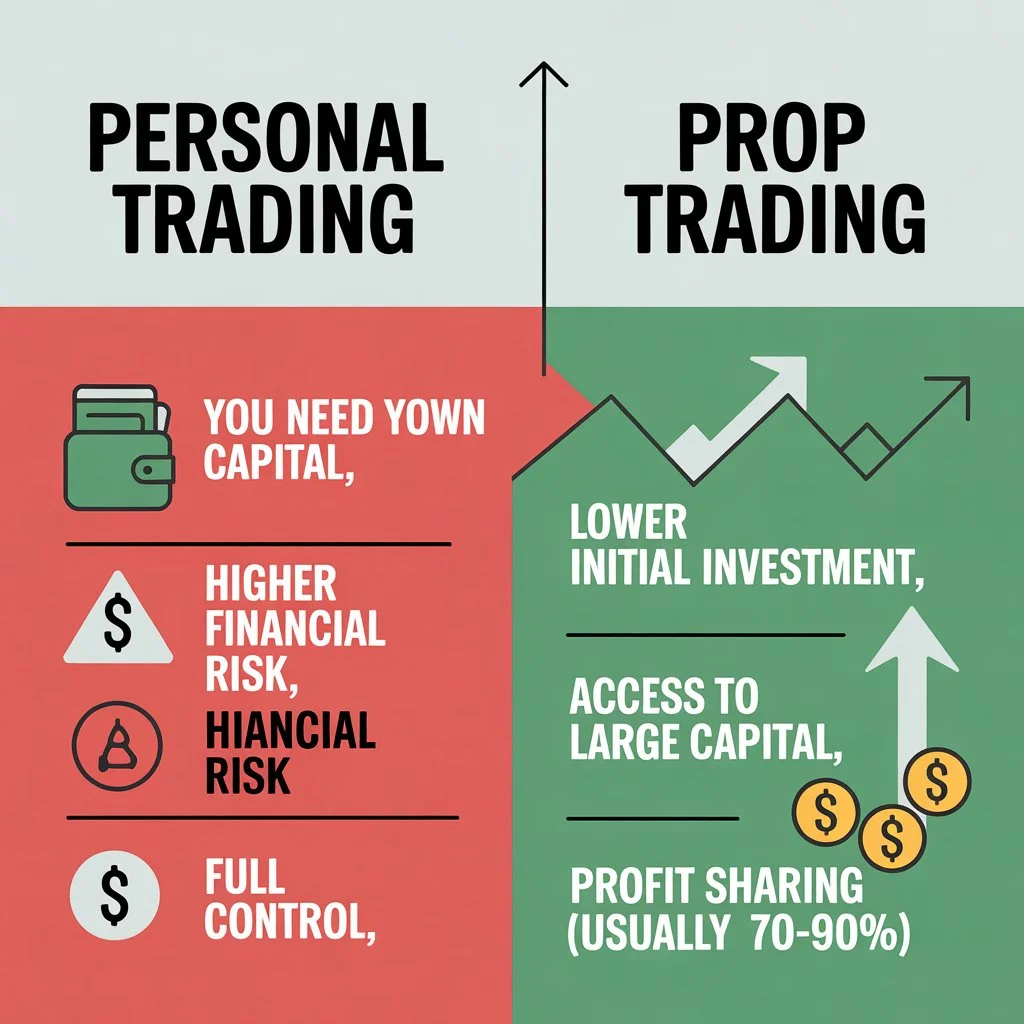
Personal Trading
- You need your own capital
- Higher financial risk
- Full control
Prop Trading
- Lower initial investment
- Access to large capital
- Profit sharing (usually 70–90%)
This is why many traders prefer prop trading funding over using their own money.
Key Trader Capital Rules Explained
Every firm has strict rules to protect their capital.
1. Drawdown Limits
You cannot lose beyond a certain percentage.
2. Daily Loss Limit
Caps how much you can lose in a single day.
3. Profit Targets
You must achieve specific returns during evaluation.
4. Position Sizing Rules
Limits how much you can trade per position.
These trader capital rules are critical—breaking them can lead to account termination.
Real Examples of Prop Trading Funding
Let’s simplify with examples:
Example 1:
- Pay $100
- Pass evaluation
- Get $25,000 account
Example 2:
- Pay $300
- Instant funding
- Get $50,000 account
Example 3:
- Join institutional firm
- No fee
- Trade firm capital after selection
These examples show how flexible prop firm minimum capital can be.
Comparison Table of Capital Requirements
| Model Type | Initial Cost | Capital Access | Risk Level | Best For |
|---|---|---|---|---|
| Evaluation Model | Low | High | Low | Beginners |
| Instant Funding | Medium | Medium | Medium | Intermediate traders |
| Traditional Prop | High | Very High | Low | Professionals |
Pros and Cons of Prop Firm Capital Models
Pros
- Low upfront cost
- Access to large capital
- Reduced personal risk
- Scalable funding
Cons
- Strict rules
- Profit sharing
- Evaluation pressure
- Possible fees
How to Choose the Right Capital Model
Choosing the right prop trading capital requirements depends on your situation.
If You’re a Beginner:
Go for evaluation-based firms with low fees.
If You Have Experience:
Consider instant funding models.
If You’re Advanced:
Apply to institutional prop firms.
FAQ Section
1. What is the minimum capital for prop trading?
The prop firm minimum capital can start as low as $50, depending on the firm and model.
2. Do I need my own money for prop trading?
Most modern firms do not require large personal capital. You usually pay a small fee instead.
3. How much trading capital is needed to succeed?
Success depends more on strategy and discipline than the trading capital needed.
4. Are prop trading firms risky?
They reduce personal financial risk, but strict rules and performance pressure exist.
5. Can I lose my account?
Yes, if you break trader capital rules like drawdown limits.
Understanding prop trading capital requirements is essential before joining any firm. The good news is that you don’t need huge capital to start. With the right approach, even a small investment can give you access to significant funding.
The key is to:
- Choose the right model
- Follow risk management rules
- Stay consiste
Ready to start your prop trading journey?
Begin with a low-cost evaluation firm, test your strategy, and gradually scale your capital. The opportunity is real—but success depends on discipline and smart decisions.